

Research Projects
Stop the VideoResearch Projects
STATUS: In Progress
YEAR: 1900
TOPIC AREA: Freight logistics and optimization
CENTER:
A Data-Driven Framework for Managed Digital Freight Corridors: Identifying Truck-Sensitive Bottleneck and Coordinating Freight Flows on California?s I-5 Corridor
Project Summary
Project Number: PSR-26-22
Funding Source: Caltrans
Contract Number: 69A3551747109
Funding AMount: $70,000
Performance Period: 10/2026 to 10/2027
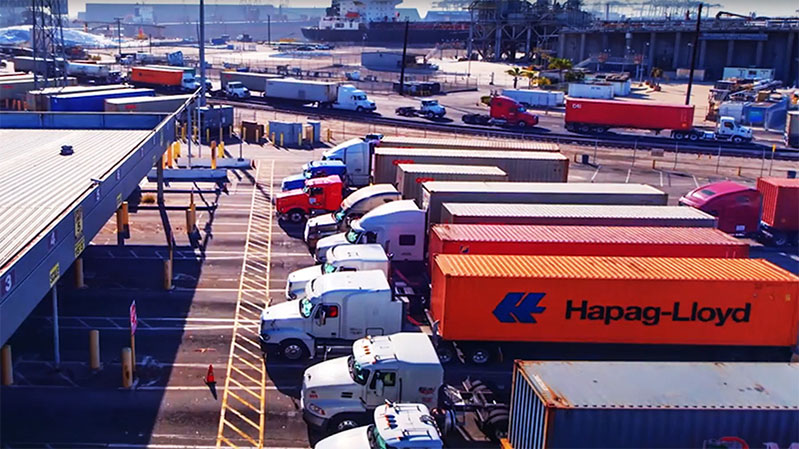
California’s I-5 corridor is a critical goods-movement backbone connecting the ports of Los Angeles and Long Beach with warehouses, agricultural regions, intermodal facilities, and major consumer markets. However, truck movements along the corridor are frequently affected by congestion hotspots, travel-time unreliability, and limited coordination between freight activity centers and highway operating conditions. Port appointments, warehouse schedules, truck dispatch decisions, and corridor traffic management are often planned separately. As a result, trucks may enter the corridor when downstream bottlenecks are already forming, contributing to degraded mixed-flow speeds, longer queues, unreliable delivery windows, higher operating costs, and increased energy consumption.
The primary goal of this research is to develop an operational framework that helps agencies, ports, and freight operators detect, predict, and manage freight-related congestion along California’s I-5 corridor. The project will identify recurring and non-recurring truck bottlenecks, evaluate the relationship between truck activity and corridor performance, develop strategies for corridor-aware freight scheduling, and define performance measures for reliability, delay, safety, energy use, and operational efficiency.
The research will advance the concept of a managed digital freight corridor. Rather than relying only on physical expansion or reactive congestion response, the project will examine how existing transportation and freight data can be used to support proactive corridor operations. The framework will use traffic speed, flow, density, occupancy, travel-time data, truck movement data, incident records, work zone information, weather data, and roadway characteristics to identify locations where truck activity is associated with recurring delay and mixed-flow speed degradation.
Major Funders
Metrans Associate Partners